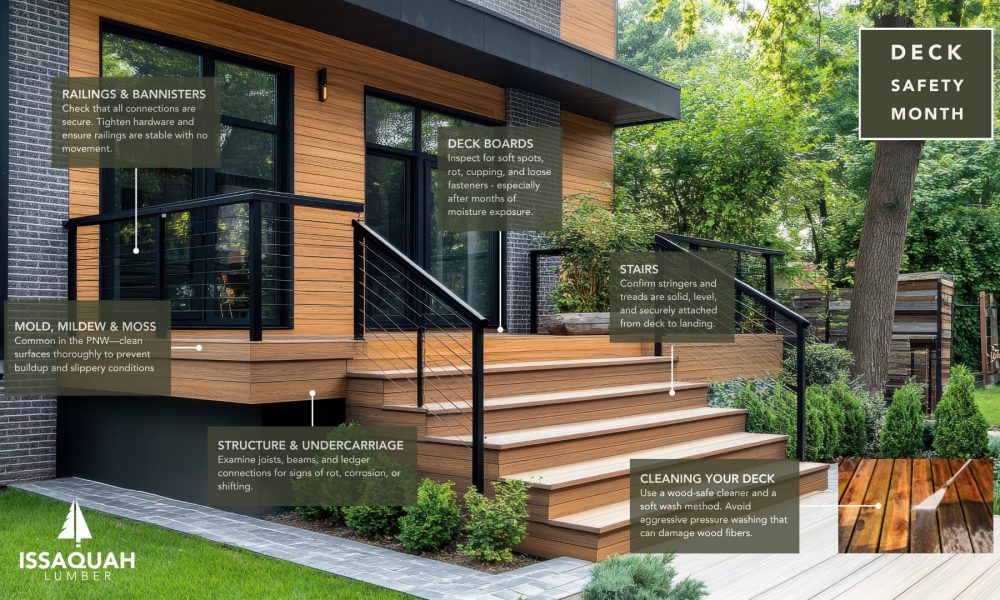
May is Deck Safety Month — the perfect time to walk your deck before barbecue season kicks into gear.
Here in the Pacific Northwest, our decks earn their keep. They weather the winter rains, endure moss and mildew season, and bake through the occasional summer heat wave. By the time May rolls around, most decks need more than just a sweep — they need a proper once-over to make sure everything is safe and solid for the season ahead.
At Issaquah Lumber, we see a lot of decks at the end of a wet winter. Here’s what we recommend homeowners check before firing up the grill.
Start with the deck surface
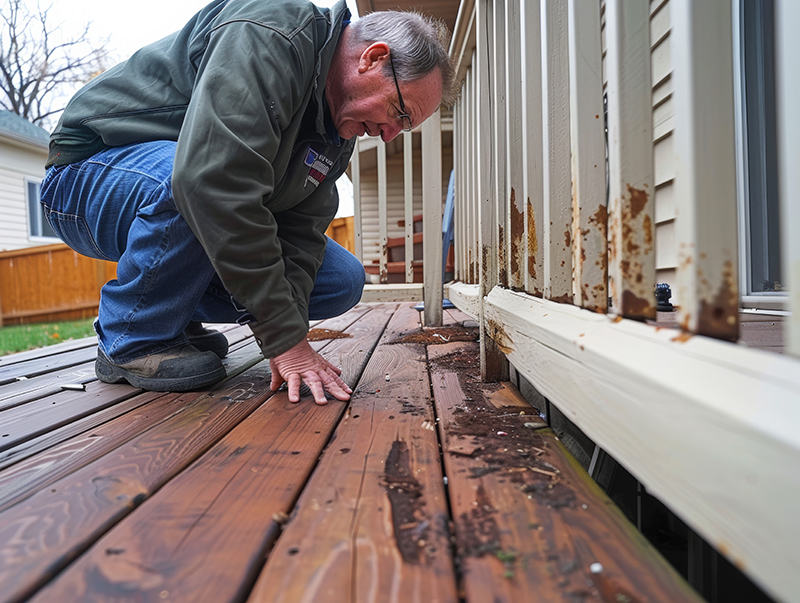
Walk every board — slowly. You’re listening for movement and looking for soft spots. In the PNW, moisture is the enemy: it works its way into wood fibers, accelerates rot, and loosens hardware quietly over time.
Check for:
- Loose, spongy, or visibly rotting boards
- Raised or rusted nails, and replace them with deck screws, which are preferred
- Missing or corroded fasteners and connectors, which can cause irreparable damage
- Support posts that may have shifted during winter ground movement
Don’t skip the railings
Railings take a lot of stress — leaning guests, excited kids, the occasional dog. Push and pull each section firmly. If anything wobbles, the fasteners need attention. This is especially important on stair railings, which bear the most load.
For cable railing systems, check that cables haven’t gone slack over the winter. Cables should not deflect more than about 4 inches under pressure. Tightening a loose cable is a quick fix — but catching it late can mean a much bigger repair.
Look underneath
The underbelly of a deck is where serious problems hide. Take a look under yours before summer.
What to look for:
- The ledger board — where your deck attaches to the house. This is one of the leading causes of deck failure when neglected.
- Joist connections and framing. Look for signs of rot, rust, or movement.
- Any evidence of insect damage: termite tunnels, carpenter ant activity, or wood that crumbles easily.
- Mold, mildew, and moss buildup, especially in shaded areas that stayed damp all winter.
Acetylation operates at the molecular level, using acetic anhydride to alter the wood’s hydroxyl groups so the wood can no longer absorb water. The result is extraordinary dimensional stability and resistance to decay, humidity, and even termites — ideal for coastal environments and high-moisture applications.
"The ledger board is where your deck meets your house — and where most deck failures start."
Check the stairs
Stair stringers should be firmly secured from the deck frame all the way down to the landing. Step on each tread and feel for any bounce or give. Check that the handrail is graspable and anchored solidly at both ends — this is a code requirement, not just a comfort issue.
A quick maintenance routine goes a long way
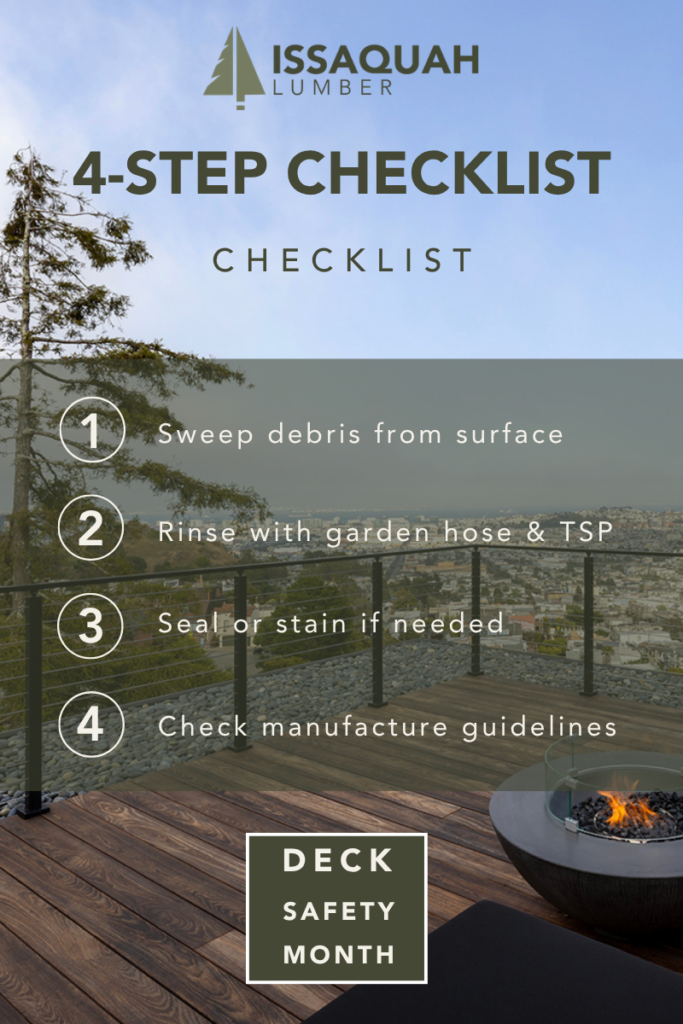
Once your inspection is done, a simple cleanup sets your deck up for the season:
- Sweep off accumulated pine needles, leaves, and debris — moisture trapped under debris speeds up rot and staining.
- Rinse with a standard garden hose and TSP (Trisodium Phosphate) to clear pollen and fine particles.
- Seal or stain wood decks if the finish is wearing thin — especially important heading into UV season.
- Check the manufacturer’s guidelines for composite decking, as it has its own care requirements.
We’re here to help
Whether you need replacement boards, new hardware, deck screws, or advice on the right finish for our rainy climate, the team at Issaquah Lumber has you covered. Stop by, and we’ll help you get your deck ready for those warm sunny days ahead.